By Mike Schmidt, Director of Industry Communications, Association of Equipment Manufacturers (AEM) --
When it comes to investing in and adopting artificial intelligence today, the business world finds itself at a crossroads.
Just about everyone is at least somewhat familiar with AI technology by now, and most corporations and institutions have experimented with it in some form or fashion. And while hype and enthusiasm for AI seems to be reaching a fever pitch, unanswered questions remain with regards to exactly how it should be developed, supported, and implemented.
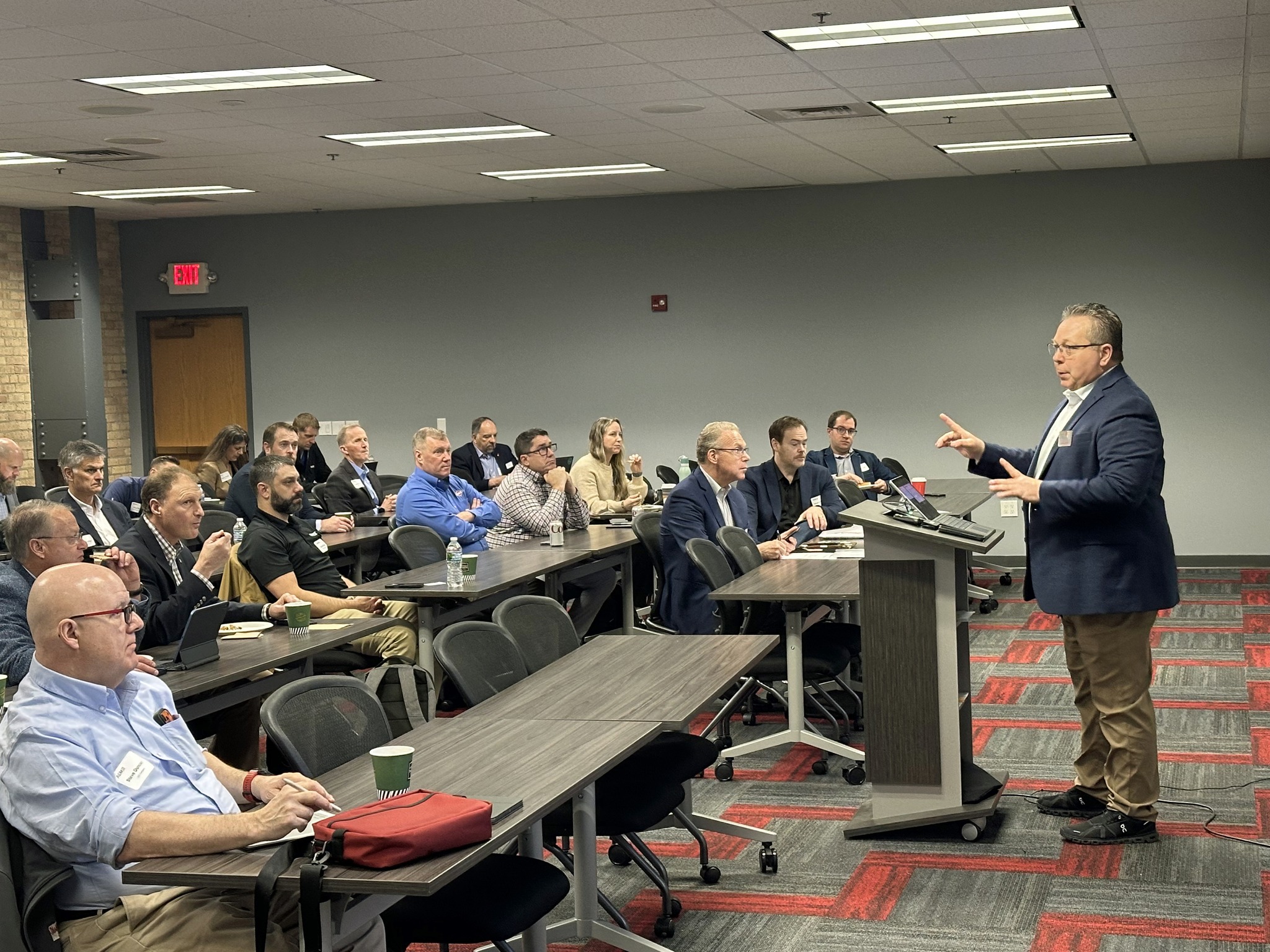
“There’s obviously a race to transform,” said Matthew Cox, executive vice president and chief data officer for AEM member company Fusable, a data infrastructure and analytics organization. Cox presented during an education session at the 2026 edition of CONEXPO-CON/AGG, North America’s largest construction trade show, last month in Las Vegas.
“Everyone is talking about how quickly to get to scale, how quickly to get an advantage, and alter the ways in which to do things,” explained Cox. “You’re trying to transform. But you’ve got to step back for a second. While you do want “first-mover” advantage, you really need to walk through things.”
Recent statistics paint a picture why. A newly published study from MIT found 95% of agentic AI initiatives launched in 2026 will fail. So, while ideation and experimentation around AI is everywhere today, not much of it has amounted to anything substantial.
“It’s difficult to be successful (in this space),” explained Cox. “You have a lot of science projects out there.”
These insights were shared during an education session held last month at CONEXPO-CON/AGG 2026. Sign up today to purchase on-demand education access.
It’s All About Data
To make measurable progress with AI, organizations need to start by understanding one thing: Whatever system, process, or information you’re providing, you must consider the structure or quality of the data you’re creating.
According to Cox, organizations should aim to:
- Craft data so it can be acted on automatically and autonomously, and without a human being part of the process
- Serve AI from a systems and data standpoint
“Data is the nutrition for AI,” said Cox. “If you give AI poor nutrition, it’s not going to run. If you give it poor structure, it’s not going to think straight. If you give it a lot of noise, it’s going to hallucinate.”
That’s why it’s so crucial for organizations to think long and hard about what they’re feeding AI, just as much (if not more) than about what the technology can offer in the near term. So often, organizations see problems arise when they attempt to build a 21st-century AI data strategy on a 20th-century data foundation. The tool makes the wrong decisions, it builds the wrong connections, or it creates inaccurate relationships.
According to Cox, the root cause of the issues is often found in what is best described as the “seams” of the organizational data.
“If there are fragmented ecosystems, or data exists in different silos, you’re in trouble,” he noted.
Organizations that make a concerted effort to move from being driven by data to being driven by insights tend to gain momentum more readily with AI adoption. More often than not, this is accomplished by embracing what’s known as a “data core strategy,” which focuses on three key elements:
- Unifying the fragmented – Rebuilding internal architecture to create a single, trusted source of truth
- Connectivity as infrastructure – Moving data into the systems where work actually happens
- Quality at the point of creation – Cleaning data so it ensures a high level of quality from the start
“Once you unify and integrate that data, and you provide mechanisms, you can see results,” said Cox. “It doesn’t take a long time to do, but you must focus on having a strong core base of data. Then building the AI on top of that becomes a whole lot easier for you to manifest.”
The Trust Component
Trust is a crucial component of AI adoption. It comes down to the ability for organizations to get people to trust it, and that’s a task far more easily undertaken than accomplished. According to Cox, two components play a role: data observability and lineage, as well as a security-first mindset.
If organizations don’t possess the visibility to look through data sequencing, or state why AI made a recommendation and trace it back, then it can be difficult to establish or maintain trust over the long term.
“Building transparency is imperative from an architectural and systems infrastructure approach, if you want to be able to have your end user customers or internal customers trust you,” Cox said.
Another way to ensure trust is by making certain security isn’t an afterthought, but rather a core architectural component, so as to ensure operational and customer data is protected.
“Take a security-first mindset,” said Cox. “You don’t want to break security, and you’ve got to explain why agentic AI made the decision it made.”
Taking the Next Step
So, how does an organization actually power agentic AI? According to Cox, there are three main ways:
- Role-based automation – Automating tasks for certain job roles and responsibilities
- Predictive market intelligence – Identifying brand loyalty and purchasing decisions to inform a customer’s next purchase
- The moment of truth application – Meeting a customer with the right solution the second they need it
“APIs (application programming interfaces) are non-negotiable,” continued Cox. “To achieve the moment of truth, AI capability really needs to have the latest, greatest, freshest, and cleanest data available. And if you’re thinking agentic AI, you need be thinking API.”
APIs provide faster times to value with drop-in product endpoints, and organizations can use existing workflows and user interfaces. No retaining or rebuilding is necessary, as APIs can place data into the tools. Finally, and perhaps most importantly, APIs allow companies to upscale as needed.
The Race to Transform
The future belongs to the companies that can leverage AI to quickly transform, get to scale, and positively impact both internal processes and customers’ experiences. According to Cox, all that can be accomplished by addressing fragmented ecosystems in four ways: auditing data silos, unifying data, leveraging a third-party data authority, and focusing on role-specific or user-specific AI.
“AI isn’t about grabbing a bunch of data and throwing it into one of the tools that are out there to build a large language model. It’s not going to lead you somewhere successful. You need to think about actionable capabilities that can scale and change the operation of your organization,” said Cox.
“Focus there,” he added.