By Gregg Wartgow, Special to the Association of Equipment Manufacturers --
With so much talk about AI (artificial intelligence) over the past couple of years, it’s hard to believe it’s still a relatively new frontier. That said, AI is now a well-established technology that manufacturers are leveraging throughout their companies to drive improvements and reduce costs.
This is particularly the case with two specific types of AI. Generative AI learns patterns from existing data to create content like text, code, images, and reports. Agentic AI uses reasoning to solve problems.
AI as a Workforce Solution
The cold, hard truth is that AI could replace some workers in some instances. Not all, but some. And when you think about it, is that a bad thing?
Many industries lost a lot of experienced, intellectual horsepower due to the COVID-19 pandemic. The average tenure at a manufacturing company dropped from 20 years in 2019 to just three years in 2023. The average time in a position also plummeted from seven years to just nine months.
“A lot of people are working in their jobs and suddenly have a hard question, but their mentor is gone,” said Danny Smith, a principal strategist for Artificial Intelligence at Amazon Web Services.
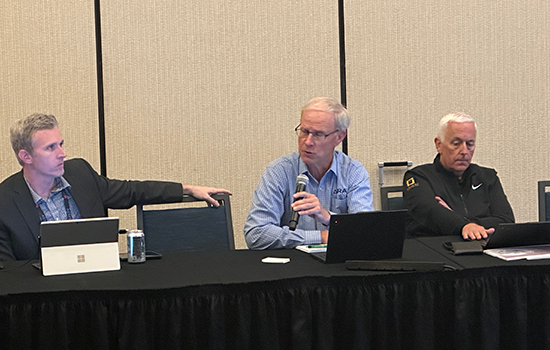
Smith spoke at AEM’s 2025 Annual Conference in November. He touched on another important workforce trend that is challenging manufacturers, the ever-widening skills gap. But for some reason, it’s not causing the same level of panic among CEOs as it historically has.
“Attracting and retaining a quality workforce is always a top-five concern for CEOs,” Smith pointed out. “What’s interesting is that it has been dropping in importance. There are many reasons for that. I would argue that one reason is that CEOs are starting to see how AI can make people more productive. Companies can do more with the same workforce than they could before.”
Generative AI Takes a Huge Leap Forward
Smith discussed how today’s Generative AI represents a vast improvement from traditional Machine Learning (ML), which includes applications like computer vision classification. With computer vision classification, a machine can classify images it sees, i.e., good or bad based on the data it has been trained on. “This is an engineer’s worst nightmare,” Smith said. “It’s like a black box because you don’t know how the machine came up with the answer it did.”
Generative AI is different in that it can understand context, which enables it to do things like predict the next word of a sentence. Thus, something called “zero-shot visual inspection” allows a machine to identify objects and patterns it has never seen before. The machine compares what it sees to a reference image of something “good,” and then applies reasoning to look for abnormal patterns, i.e., a crack or other defect in a part.
Join AEM member company executives and the next generation of industry leaders at the 2026 AEM Annual Conference, set for Nov. 10-12, 2026, at the JW Marriott Tucson Starr Pass Resort & Spa in Tucson, Arizona. To learn more, visit aem.org/annual.
Examples of AI in Play Today
Smith said both Generative and Agentic AI are being utilized by manufacturers across their companies for a variety of tasks, including:
- Product engineering – generative and accelerated design, standards compliance, and warranty analytics
- Smart manufacturing – guided maintenance and repair, quality diagnostics, new hire onboarding, reskilling and upskilling, and root cause failure analysis
- Digital customer experience – call center assistants, on-product assistants, marketing content, dealer enablement and training, and field service diagnostics
Smith also shared data quantifying how the use of AI is positively impacting companies:
- Sales assistants gave fours per week back to sales reps
- Engineering requirements assistants gave two to three hours back to engineers
- Root cause assistants sliced field service diagnostic time by 24%
- Manufacturing maintenance chatbots sliced average downtime by 75%
Smith then discussed some detailed examples of where he has seen companies reap great dividends from their use of Generative and Agentic AI.
RFP response. Smith shared a story of a company he’d worked with that used Agentic AI to automate the process of responding to RFPs. For one, responding to RFPs is time-consuming. AI solved for that. AI also helped improve the quality of the finished proposal. The company was diverse and somewhat siloed. One division didn’t have clear line of sight into what another division was doing. That made it difficult to create complete proposals in a timely fashion. Agentic AI, on the other hand, has been able to scour across divisions to make sure all applicable products and solutions are included in the proposal.
“The general manager told me that the company hasn’t seen an increase in win rate, but they have seen their annual deal size increase by $200,000,” Smith said.
Production meeting planning. Smith said these quick 15-minute meetings at the start of a shift require, on average, two hours of preparation per functional lead. “Wouldn’t it be nice if everyone could ask AI to quickly generate the data and information needed for that day’s meeting? Now they can,” Smith said.
SOP creation. “Think about all of those thick manuals you have,” Smith said. “By using a safe, internal AI model — not something external like ChatGPT — you could feed a huge document into the system and allow it to analyze it and create an app. You can still adjust things later if you want.”
Data analysis. “Think about how many ‘analysts’ you have in your company,” Smith said. “What if they could ask questions of their data? Maybe a sales manager wants to know how their team can start generating more profitable sales. That sales manager could tell their Generative AI model, ‘Build me a story explaining product profitability trends. How can our sales managers increase profitability in their specific regions?’ Then the sales manager can allow the AI agent to reason on their behalf.”
Automate workflows. A small manufacturer in Texas was still following a laborious process of accepting customer orders via email. Then a human customer service agent would read the email, go through each line item, and make sure the order was fulfilled. Smith said the CFO/CIO recognized how inefficient that was and set out to find a better solution. He found one in an AI tool called Drag & Drop AI. “They created an Agentic AI workflow that has automated 97% of that process, with the other 3% being reserved for humans because they identified certain risk factors that require human verification,” Smith said.
Embarking on a Path Toward AI
The examples described above are just a sampling of what manufacturing companies are already doing with Generative and Agentic AI. Smith offered the following advice for companies that want to better utilize AI to help solve the workforce, engineering, sales, production, and administrative challenges that are holding their organizations back.
“Company leaders must embrace the new, and can’t become an obstacle to their own success,” Smith said. “Enabling the entire organization is also effective. Individual teams know where the value in AI lies, so let them explore.”
It’s also important to get off on the right foot. Smith said manufacturers can lean on their vendors for capabilities if they don’t have the right internal resources. Then, it’s critical to identify the right use cases where the most ROI will be seen. “Where do you already have good data and good people with the right skills?” Smith asked.
Finally, companies must acknowledge that leveraging AI will require some change management. Utilizing Generative and Agentic AI is like adding another co-worker to your employees’ teams. When implemented correctly, it can make everyone more efficient and productive.