AEM’s global advocacy efforts in support of the Cape Town Convention’s (CTC) Mining, Agriculture, and Construction (MAC) Protocol moved on to the United Kingdom this month, highlighting the imperative to create an international legal framework for securing interests in high-value mobile equipment at two international conferences.
AEM’s Kip Eideberg, Senior Vice President of Government and Industry Relations, and Alex Russ, Senior Advisor Global Public Policy, participated in the 14th Annual Cape Town Convention Academic Project Conference in Cambridge. The focus of this year’s conference was Treaty implementation and the Cape Town Convention, and the two discussed various CTC-specific issues in relation to the MAC Protocol with leading academics and Cape Town Convention experts.
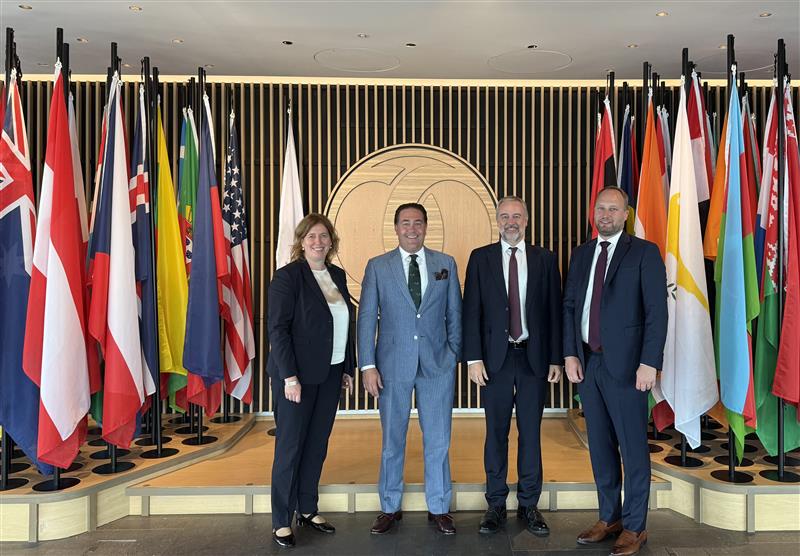
The two then moved on to London to participate in an international conference titled Facilitating economic growth through trade and finance – a focus on the Mining, Agricultural and Construction (MAC) Protocol and Rail Protocol. The event, which was organized by UNIDROIT and the European Bank for Reconstruction and Development (EBRD), brought together diplomatic representatives, government officials, financiers, legal practitioners, academics, and industry representatives, for a series of panels on how the two protocols operate in practice and will facilitate economic growth and trade through equipment finance.
Alex Russ led a discussion with industry representatives on the benefits of the MAC and Rail Protocols and highlighted the importance of the MAC Protocol in addressing economic, societal, and environmental challenges in emerging markets. During his opening remarks, Alex Russ remarked:
“The MAC Protocol requires a coordinated international effort to realize the benefits of what promises to be one of the most important commercial law instruments aimed at improving economic growth, food security, and infrastructure development. Each attendee here today, regardless of your geographical location, has an important role to play in making the treaty a success. Governments that ratify the MAC Protocol will improve the lives of their citizens by lowering the cost of modern and more sustainable mining, agriculture and construction equipment. Equipment that increases agricultural yields while drastically cutting the need for water, herbicides and pesticides. Construction and mining equipment that uses less fuel, has lower emissions, is safer to operate, and decreases infrastructure costs.
As the North American-based trade association representing over 1,100 member companies in the mining, agriculture, and construction sectors, AEM has joined industry colleagues across Europe, Asia, and South America to advocate for the ratification and adoption of the MAC Protocol. It is my hope that after today’s event you will join us in this effort to improve the livelihoods of farmers and workers across the globe.”
Diplomatic representatives from Algeria, Argentina, Azerbaijan, Brazil, Burkina Faso, Cameroon, Czech Republic, Ecuador, Georgia, Greece, Hungry, Indonesia, Jamaica, Kenya, Kyrgyz Republic, Nigeria, Sudan, Tajikistan, Togo, Turkmenistan, Türkiye, Ukraine and the United States attended the discussion.
The MAC Protocol creates an international legal framework for securing interests in high-value mobile equipment in the mining, agriculture, and construction sectors. Historically, foreign lenders have hesitated to finance such equipment in emerging markets because repossession and enforcement are difficult in cases of default. The MAC Protocol changes this by granting creditors international rights, enforceable across states, reducing risk and lowering borrowing costs.
Importantly, the MAC Protocol facilitates cross-border leasing and financing, making it easier for customers in emerging markets to acquire equipment without prohibitive upfront costs. This legal certainty will make it easier for global lenders, equipment manufacturers, and leasing companies to expand into emerging markets, unlocking growth in industries that are capital intensive but also critical to long-term growth and economic development.
AEM will continue to lead the equipment manufacturing industry’s global advocacy efforts in support of the ratification of the MAC Protocol and will participate in the upcoming APEC Technical Workshop in Tokyo in October.