By Dave Hughes, Vice President of Global Sales, McElroy Manufacturing --
It is not uncommon for water utilities to lose up to 40% of their treated water. To put that into perspective: the average family uses more than 9,000 gallons per year, yet utilities may need to source, treat, and pump roughly 15,000 gallons just to deliver that amount.
That is not just inefficiency—it is wasted energy, wasted chemicals, and wasted capital.
Two core issues drive this reality: decades of underinvestment in underground infrastructure and the slow pace of change common in many public systems. For years, the industry has focused on expanding supply, while the systems delivering that water have quietly deteriorated.
But that is beginning to change.
Utilities across North America are now taking a more aggressive, multi-pronged approach to reducing water loss and improving performance. Digital tools such as advanced metering infrastructure (AMI), leak detection, and real-time monitoring are giving operators unprecedented visibility into their systems—allowing them to identify losses and act faster than ever before.
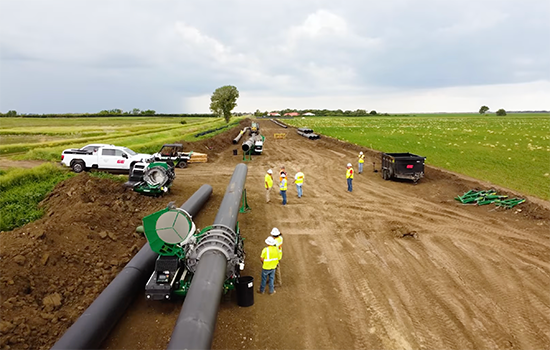
At the same time, utilities recognize that technology alone is not enough. The materials used in the system matter just as much. Traditional piping systems fail most often at the joint—the weakest point in the network. Modern piping systems such as HDPE fundamentally change that equation. Through heat fusion, joints become stronger than the pipe itself, effectively eliminating leaks at their most common source and creating fully restrained, leak-free systems.
The benefits extend beyond water loss. Aging metallic pipes corrode and tuberculate, degrading water quality and driving higher chemical usage. In contrast, HDPE systems are inert and non-corrosive, helping utilities maintain water quality while often reducing the need for chlorination.
At the system level, utilities are also advancing reuse and circularity—deploying reclaimed water systems and decentralized treatment to extend the value of every gallon produced.
The impact of these combined efforts is already measurable. Despite population growth and aging infrastructure, utilities are becoming significantly more efficient. Modern practices are saving nearly 4 trillion gallons of water annually across the U.S. and Canada—water that no longer needs to be sourced, treated, or transported.
This progress reflects a fundamental shift: from expanding supply to optimizing delivery.
Several forces are accelerating this shift:
- Data-driven asset management and system visibility
- A relentless focus on reducing non-revenue water
- Adoption of longer-lasting, leak-resistant materials
- Increased pressure to meet sustainability and stewardship goals
Technological advancements across the agriculture, construction, and utility industries are enabling organizations to achieve significantly greater output while using substantially less water. Learn more by downloading AEM’s comprehensive study, From Source to Solution: Advancing Water Stewardship in the Non-Road Sector.
However, the challenge remains substantial. An estimated $625 billion in investment will be required over the next 20 years to bring water systems to a good state of repair. Much of today’s infrastructure is already beyond its intended life, and every year of delay increases both cost and risk.
The encouraging reality is that investment works. Water main break rates have declined by approximately 20% from 2018 to 2023—driven largely by replacing aging cast iron and asbestos cement pipes with modern plastic systems, combined with expanded use of leak detection technologies.
Utilities that are acting decisively are already seeing results. Communities such as Duluth, MN; East Bay Municipal Utility District (CA); Palo Alto, CA; Arlington, TX; Seattle, WA; and Fort Lauderdale, FL are demonstrating that modern infrastructure can dramatically reduce water loss, improve reliability, and lower lifecycle costs.
The takeaway is clear: the problem is not a lack of water—it is how efficiently we manage and deliver it. The next decade will not be defined by expanding supply, but by how aggressively utilities modernize the systems that deliver it.
Dave Hughes is Vice President of Global Sales at McElroy Manufacturing, a manufacturer of reliable, efficient, rugged, and technically advanced pipe fusion equipment.